November 20, 2026
Call (416) 828-6976Upgrading from 100-Amp to 200-Amp in Ontario: Costs, Utility Disconnect & Step-by-Step Process
Related Service
Panel Upgrades
Upgrade your electrical panel for improved safety, capacity and reliability.
On this page
- 1. What Does an Electrical Panel Upgrade Involve? (It Is Far More Than Swapping a Box)
- 2. Coordinating with Your Local Utility: Toronto Hydro, Alectra & Hydro One
- 3. Understanding Electrical Panel Upgrade Costs: Why Custom Assessments Are Mandatory
- 4. Critical Warning Signs: When a Panel Upgrade Is Urgently Needed
- 5. Adding Modern High-Draw Appliances: Why 100 Amps Is No Longer Enough
- 6. The Legal Reality: Why Panel Upgrades Must Be Completed by a Licensed Electrical Contractor
- 7. Serving Toronto and the Entire Greater Toronto Area (GTA)
- Upgrade Your Electrical Service with Confidence
If you own an older home in Toronto or anywhere across the Greater Toronto Area (GTA), your electrical system is likely operating on a 100-amp distribution panel. When these homes were constructed decades ago, a 100-amp electrical service was more than adequate for incandescent lighting, a refrigerator, a television, and basic household appliances.
Today, residential power demands have fundamentally transformed.
Between Level 2 EV charger installations, cold-climate heat pumps, finished basement rental apartments, backyard swim spas, and high-draw kitchen renovations, homeowners are pushing their existing 100-amp panels past their engineered limits. When a panel is overloaded, the symptoms appear quickly: nuisance breaker trips, flickering lights when heavy appliances cycle on, hot breaker covers, and the inability to add any new electrical circuits.
If you are planning major renovations or adding modern electrical amenities, an upgrade from 100-amp to 200-amp electrical service in Ontario is no longer a luxury—it is an essential foundation for safety, property value, and future home electrification.
This definitive guide breaks down everything Ontario property owners must know about the 200-amp service upgrade process: what physical hardware must be replaced, how utility coordination with Toronto Hydro and Alectra Utilities works, why insurance companies demand panel upgrades, and how to obtain an accurate, tailored quotation from a Licensed Electrical Contractor (LEC).
1. What Does an Electrical Panel Upgrade Involve? (It Is Far More Than Swapping a Box)
One of the most widespread myths among homeowners is that upgrading an electrical panel simply involves taking off an old metal box inside the basement and mounting a larger 200-amp breaker panel in its place.
Under the Ontario Electrical Safety Code (OESC), electrical safety is a continuous system: every component from the utility connection point at the street down to the branch circuit wiring must be rated to safely carry 200 amperes of continuous current.
A complete 200-amp service upgrade requires replacing and upgrading five critical physical components:
| 200A Service Component | Hardware Specifications (OESC Compliant) | Critical Role & Engineering Function |
|---|---|---|
| 1. Service Entrance Feeder | Heavy 2/0 AWG copper or 4/0 AWG aluminum conductors; overhead mast or underground conduit | Delivers 200-amp continuous current safely from the utility grid to the home without thermal overheating. |
| 2. Exterior Meter Base | Heavy-duty, CSA-approved 200-amp meter socket enclosure (Toronto Hydro / Alectra approved) | Replaces obsolete 100A meter socket to safely house the utility smart meter and isolate incoming utility feed. |
| 3. Main Distribution Panel | Modern 200A breaker panel board (40–60 circuit spaces) with main shutoff breaker | Distributes high-amperage power across household branch circuits with integrated AFCI and GFCI breaker technology. |
| 4. Grounding & Bonding System | Dual copper-clad ground rods (or grounding plate) + solid copper bonding to water/gas lines | Neutralizes voltage spikes, eliminates stray current, and provides critical touch-potential shock protection. |
| 5. Whole-Home Surge Protection | Type 2 Surge Protective Device (SPD) mounted directly to the main bus bar | Shields sensitive home electronics, EV chargers, and heat pump control boards from utility switching surges. |
1. The Service Entrance Conductors & Mast / Underground Lateral
The incoming electrical conductors carrying power from the utility line to your home must be replaced. A 100-amp service typically uses smaller gauge wire (such as #2 or #3 copper). Upgrading to 200 amps demands substantially thicker conductors—typically 2/0 AWG copper or 4/0 AWG aluminum—capable of handling double the amperage without overheating.
For homes with overhead power lines, the exterior conduit mast, weatherhead, and roof-flashing assembly must be rebuilt. For homes with underground lateral feeds, conduit sizing must meet utility specifications.
2. The Exterior Meter Base Replacement
The metal enclosure on the outside of your home where the utility meter is seated is rated specifically for amperage capacity. A 100-amp meter base cannot legally or physically accommodate 200-amp utility metering. During an upgrade, the old exterior socket is removed and replaced with a certified, heavy-duty 200-amp meter base approved by your local electrical distribution company.
3. The Main Distribution Breaker Panel
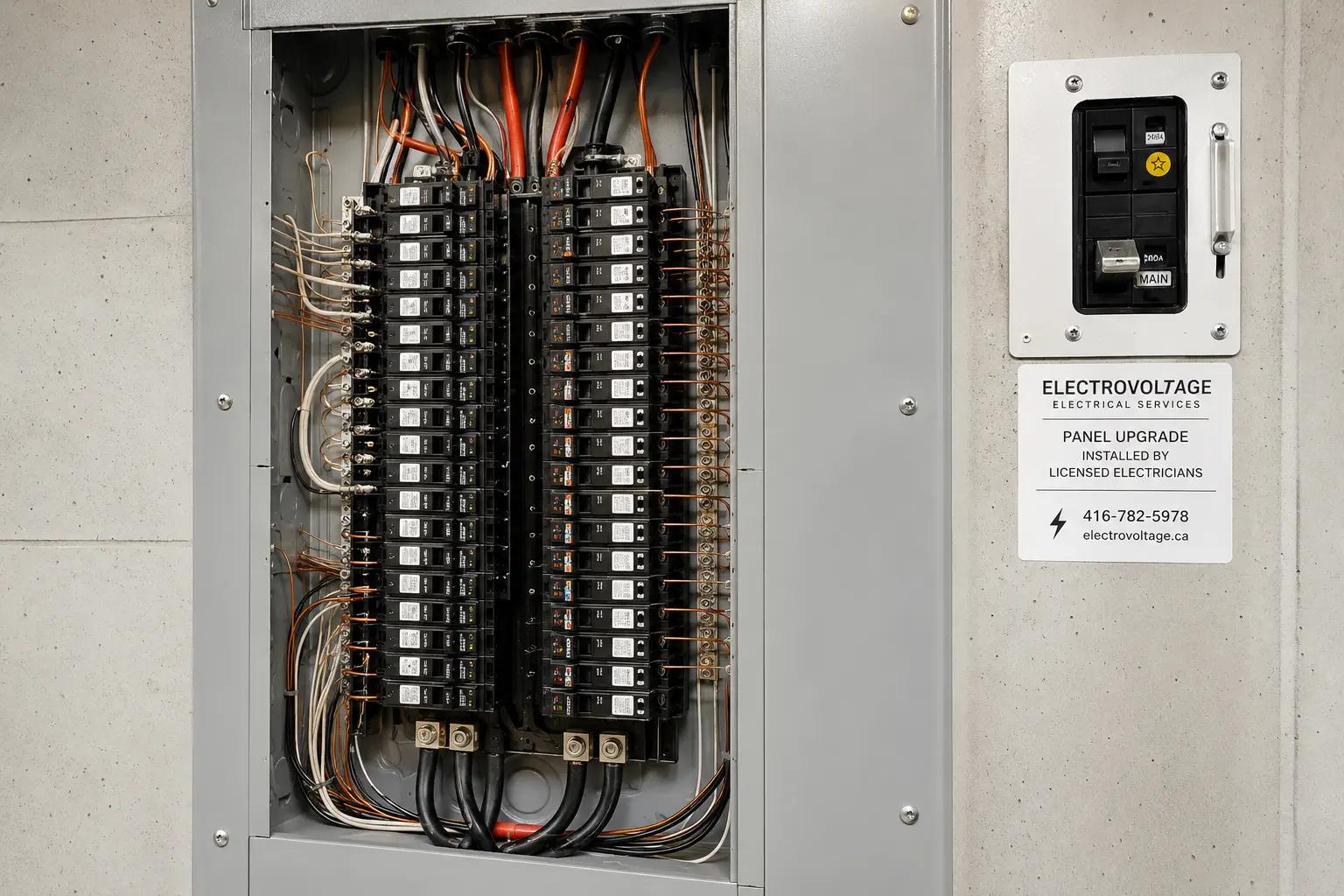
Inside your utility room or basement, your aging 100-amp panel (or obsolete fuse box) is completely replaced with a modern, high-capacity 200-amp panel board. These modern panels provide 40 to 60 circuit breaker spaces, allowing ample capacity to balance household loads and provide expansion room for future electrical needs.
4. Grounding Electrode & System Bonding
Over time, grounding standards in Ontario have evolved. An upgraded 200-amp panel must be tied into a fully code-compliant grounding electrode system—typically utilizing dual copper-clad ground rods driven deep into the earth or an approved grounding plate, paired with solid copper bonding to your incoming municipal metallic water supply line and interior gas piping.
5. Whole-Home Surge Protection & Advanced Breakers
Modern electrical codes mandate or strongly recommend integrating Whole-Home Surge Protection Devices (SPDs) directly into the new panel to safeguard sensitive electronics, smart appliances, and EV battery charging systems from utility voltage spikes.
2. Coordinating with Your Local Utility: Toronto Hydro, Alectra & Hydro One
Unlike minor interior wiring adjustments, an electrical service upgrade cannot be executed in isolation. It involves an intricately coordinated sequence between your electrical contractor, your municipal electric utility company, and the Electrical Safety Authority (ESA).
In the Greater Toronto Area, your utility provider is determined by your municipality:
- Toronto Hydro: Serves the City of Toronto, including Downtown, North York, Etobicoke, and Scarborough.
- Alectra Utilities: Serves major GTA regions including Mississauga, Vaughan, Markham, Richmond Hill, and Hamilton.
- Hydro One: Serves rural and suburban pockets across Ontario.
- Oshawa Power & Whitby Hydro: Serves regions across Durham.
The Single-Day Power Outage Process
Homeowners are often concerned that upgrading their electrical service will leave them without electricity, heating, or refrigeration for days.
When you work with an experienced Licensed Electrical Contractor, the power outage is completed in a single, tightly managed workday—typically lasting between four and seven hours.
| Time Window | Operational Milestone | Key Contractor & Utility Actions |
|---|---|---|
| 07:30 AM – 08:30 AM | Site Preparation & Staging | Electrical contractor arrives on-site; workspace protection and equipment staging. |
| 08:30 AM – 09:30 AM | Utility Grid Isolation | Utility crew (Toronto Hydro / Alectra) disconnects power safely at the street. |
| 09:30 AM – 01:30 PM | Service Hardware Installation | Old panel/meter base removed; new 200A mast, meter socket, and panel board installed. |
| 01:30 PM – 02:30 PM | Mandatory ESA Field Inspection | Provincial ESA Inspector conducts comprehensive on-site rough-in & service inspection. |
| 02:30 PM – 03:00 PM | Connection Authorization Issued | ESA Inspector transmits official digital Connection Authorization to utility dispatch. |
| 03:00 PM – 04:30 PM | Utility Meter & Reconnection | Utility crew returns, installs new 200A utility meter, and safely re-energizes power. |
| 04:30 PM – 05:30 PM | Testing, Labeling & Clean-up | Full voltage verification across all circuits, breaker labeling, and complete clean-up. |
Because your contractor must receive official Connection Authorization from the ESA inspector before the utility company is legally permitted to reconnect power, hiring a reputable contractor who guarantees code-compliant execution on the first visit is paramount to avoiding extended outages.
3. Understanding Electrical Panel Upgrade Costs: Why Custom Assessments Are Mandatory
Property owners frequently search online for a quick, fixed dollar estimate for a 200-amp panel upgrade. However, every home possesses a unique physical layout, structural age, and utility connection path, making standardized flat-rate online pricing misleading and inaccurate.
Reputable Licensed Electrical Contractors do not provide blind pricing without evaluating the specific structural and electrical parameters of your property.
Key Site Variables That Determine Your Upgrade Investment:
| Cost Factor | Why It Impacts the Overall Project Scope |
|---|---|
| Overhead vs. Underground Feed | Overhead connections require rebuilding exterior conduit masts and roof weatherheads. Underground feeds may involve civil trenching, ground conduit, or utility cable pulls if existing conduits are undersized. |
| Distance: Meter Base to Panel | If your exterior electric meter sits on the opposite side of your house from your interior panel, pulling heavy 2/0 gauge copper through finished ceilings or joists requires significantly more labor and materials than a back-to-back installation. |
| Utility Disconnection / Connection Scope | Each local utility (Toronto Hydro, Alectra Utilities, Hydro One) maintains distinct administrative processes, engineering layout fees, and connection protocols depending on neighborhood infrastructure. |
| Pre-Existing Code Deficiencies | Older century homes in Toronto or 1960s properties in North York may contain ungrounded circuits, hazardous aluminum wiring, or tangled subpanels that must be corrected to pass the mandatory ESA inspection. |
| Replacing a Fuse Box vs. Breaker Panel | Converting an obsolete 60-amp screw-in fuse box requires extensive circuit tracing, junction box consolidation, and circuit labeling compared to swapping an existing 100-amp breaker box. |
Avoid Hidden Charges and Low-Ball Estimates: Unlicensed operators often advertise rock-bottom prices, only to hit homeowners with surprise fees for permits, meter bases, or grounding upgrades once your power is already dismantled. Always partner with a contractor who provides a comprehensive, all-inclusive written proposal that covers all permits, utility coordination, and inspection sign-offs.
Contact our licensed master electricians today to arrange a thorough, no-obligation on-site assessment for your property.
4. Critical Warning Signs: When a Panel Upgrade Is Urgently Needed
While many panel upgrades are scheduled proactively during renovations, thousands of GTA properties operate with panels that pose immediate safety, fire, and home insurance risks.
If your property exhibits any of the following warning signs, your electrical service demands immediate professional evaluation:
1. You Have a Federal Pacific Electric (FPE) or Zinsco Breaker Panel
If your electrical panel features the brand name Federal Pacific Electric (FPE), Stab-Lok, or Zinsco, you are living with a documented fire hazard. Extensive independent engineering studies have proven that FPE Stab-Lok and Zinsco circuit breakers fail to trip under overcurrent conditions at an alarming rate—sometimes exceeding 25% to 50% non-trip failure rates.
When a breaker jams and fails to trip during a short circuit, electric current continues to surge, overheating wires inside your walls until framing catches fire. Most major Ontario home insurers will refuse coverage or cancel policies upon discovering an active FPE or Zinsco panel.
2. You Still Have an Old Fuse Box (60-Amp or 100-Amp)
If your home relies on round, screw-in glass fuses, your electrical service is several decades past its intended lifespan. Common risks include:
- Overfusing: Inserting a 20-amp or 30-amp fuse into a 15-amp circuit because the correct fuse keeps blowing—forcing wiring to carry dangerous current beyond its thermal rating.
- Corrosion & Loose Contacts: Decades of humidity cause fuse socket threads to oxidize, generating extreme heat and localized arcing.
- Insurer Ultimata: Ontario insurance carriers routinely issue cancellation notices to homeowners with 60-amp fuse services, demanding immediate upgrades to 100A or 200A breaker panels.
3. Frequent Breaker Tripping and Flickering Lights
Do your lights dim noticeably when your refrigerator compressor kicks on, or when someone turns on a microwave while the air conditioner is running? This is a clear indicator of voltage drop caused by a main electrical service that is struggling to deliver the peak current requested by your household.
4. Warm Panel Covers, Buzzing Sounds, or Acrid Smells
An electrical panel should run cool and quiet. If you touch your panel cover and feel warmth, hear a faint humming or buzzing sound near specific breakers, or detect a fishy, plastic-burning odor, electrical arcing or loose bus-bar connections are occurring. This is an urgent electrical emergency requiring immediate attention from a 24/7 emergency electrician.
5. Adding Modern High-Draw Appliances: Why 100 Amps Is No Longer Enough
The rapid transition toward residential electrification across Southern Ontario has made 200-amp service the new standard for modern living.
Consider the cumulative electrical draw of typical high-demand residential systems:
| Modern Appliance / System | Typical Dedicated Circuit Amperage | Why 100A Panels Fail |
|---|---|---|
| Level 2 EV Charging Station | 40A to 50A continuous | Consumes nearly 50% of an entire 100-amp home's total capacity during charging hours. |
| Central Air Conditioning / Heat Pump | 30A to 50A | Significant inrush starting current paired with continuous summer/winter operation. |
| Electric Heating Auxiliary Elements | 40A to 60A | High continuous winter load required for cold-climate heat pump backup staging. |
| Finished Basement Rental Suite | 50A to 60A subpanel | Independent kitchen, laundry, heating, and living circuits require dedicated capacity. |
| Outdoor Hot Tub or Swim Spa | 50A to 60A | Continuous high-load heating elements running simultaneously with multi-horsepower pumps. |
| Electric Induction Range / Double Oven | 40A to 50A | Massive peak draw during holiday cooking and multi-element meal preparation. |
When you sum the simultaneous demand of these systems using the standard load calculation formulas established in Section 8 of the Ontario Electrical Safety Code, a 100-amp service is mathematically incapable of supporting these modern amenities safely.
Upgrading to 200 amps provides the necessary electrical headroom, ensuring your breakers never trip under concurrent household usage.
6. The Legal Reality: Why Panel Upgrades Must Be Completed by a Licensed Electrical Contractor
In Ontario, an electrical panel upgrade is strictly regulated under the Electricity Act. Property owners are legally prohibited from performing service entrance replacements or pulling utility meters themselves.
Working with utility voltages ahead of the main breaker involves massive arc-flash and electrocution hazards that carry lethal consequences.
Why You Must Work Exclusively with an ECRA/ESA Licensed Electrical Contractor:
| Requirement / Standard | Unlicensed Handyman / Casual Tradesperson | Electrovoltage (ECRA/ESA #7017240) |
|---|---|---|
| Legal ESA Permit Authority | Prohibited from pulling permits | Full legal authorization to file permits |
| Utility Connection Authority | Cannot coordinate with Toronto Hydro/Alectra | Direct dispatch coordination for disconnect/reconnect |
| Master Electrician Oversight | Uncertified knowledge; code non-compliance | Licensed Master Electricians on every project |
| Liability Insurance & WSIB | No commercial electrical liability coverage | Comprehensive commercial liability & WSIB coverage |
| Inspection Outcome | Risk of power shutoff & Defect Notices | Guaranteed first-time pass & Certificate of Acceptance |
| Home Insurance Recognition | Work rejected by insurance carriers | Full compliance documentation accepted by all insurers |
Hiring an uncertified handyman who claims they can "swap your panel on the weekend" exposes you to catastrophic risks. Because they cannot legally pull an ESA permit or schedule an authorized utility disconnect, rogue operators frequently attempt to work on live high-voltage lines or cut utility security meter tags—criminal offenses under provincial law that result in immediate utility disconnects, heavy fines, and uninsurable properties.
7. Serving Toronto and the Entire Greater Toronto Area (GTA)
Our licensed electricians deliver complete, code-compliant electrical panel upgrades, service replacements, and utility coordination across all primary GTA service areas:
- Toronto & Central Core: Century home service upgrades, overhead mast rebuilds, and direct Toronto Hydro coordination across The Annex, Riverdale, Leslieville, and High Park.
- North York: 100A to 200A upgrades, aluminum branch circuit remediation, and subpanel additions in Newtonbrook, Willowdale, and Don Mills.
- Vaughan & Woodbridge: Panel upgrades for high-draw executive homes, EV charger installations, and commercial distribution boards.
- Etobicoke: Replacing aging fuse boxes and Federal Pacific panels, overhead service updates, and standby generator integrations in The Kingsway, Mimico, and Alderwood.
- Markham & Richmond Hill: Complete service entrance upgrades, Alectra Utilities coordination, and capacity expansion for finished rental basements.
- Mississauga & Oakville: Underground lateral service upgrades, high-capacity residential breaker panels, and pool/hot tub power feeds.
- Scarborough: Knob-and-tube panel replacements, multi-circuit modernizations, and legal basement suite subpanels.
- East Gwillimbury & Newmarket: High-amperage heat pump conversions, rural property panel replacements, and backup generator transfer switches.
Upgrade Your Electrical Service with Confidence
Your electrical panel is the beating heart of your home. Entrusting your service upgrade to seasoned professionals ensures your family’s safety, protects your valuable electronics, satisfies all home insurance requirements, and adds lasting market value to your property.
At Electrovoltage, we eliminate every stress point. From filing the initial ESA notification of work and engineering the service load to coordinating the utility disconnect and delivering your official Certificate of Acceptance, our master electricians handle the entire process seamlessly in a single day.
Contact our team today to discuss your project requirements and schedule your comprehensive, on-site electrical panel assessment:
- 📞 Direct Phone: (416) 828-6976
- 📧 Email Inquiries: info@electrovoltage.ca
- 🌐 Online Consultation: Schedule Your Panel Upgrade Assessment Online
- 🛡️ Licensing & Credentials: Fully Licensed Electrical Contractor (ECRA/ESA #7017240) | Fully Insured | WSIB Coverage