November 22, 2026
Call (416) 828-6976Standby Generator Installation in Ontario: Sizing, Transfer Switches & ESA Codes
Related Service
Generator Installation
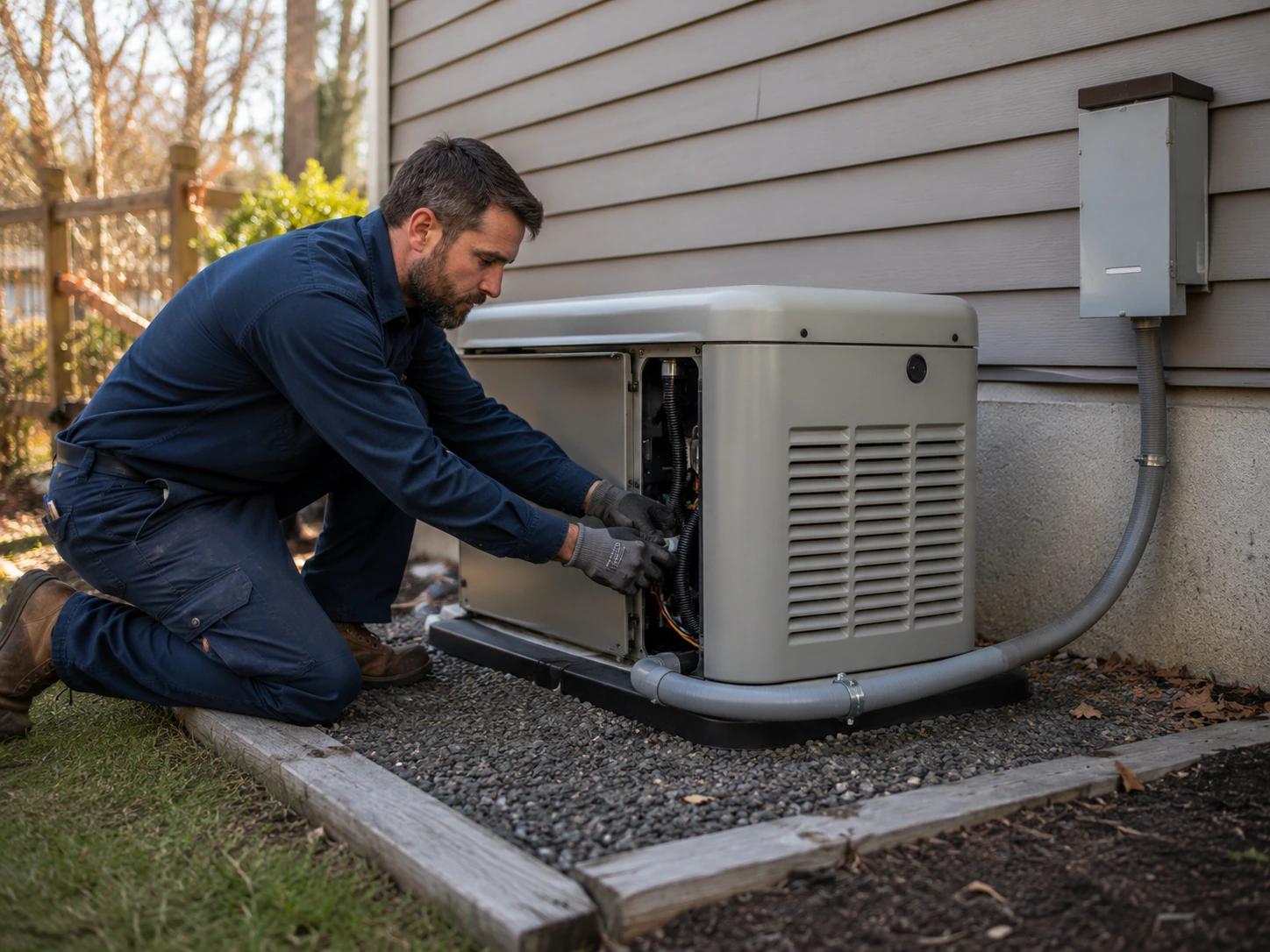
Standby generator installation and backup power systems for homes and businesses.
On this page
- 1. Portable vs. Whole-Home Standby Generators: Engineering Comparison
- 2. Standby Generator Sizing: How Many Kilowatts (kW) Does Your Home Need?
- 3. The Brain of the System: How the Automatic Transfer Switch (ATS) Works
- 4. Regulatory Compliance: ESA Electrical Standards & TSSA Gas Clearances
- 5. What Factors Determine Your Project Scope? (Why Custom Quotes Are Mandatory)
- 6. Industry-Leading Standby Generator Brands We Install & Maintain
- 7. Serving Toronto and the Entire Greater Toronto Area (GTA)
- Secure Your Home with Reliable Standby Power
Winter in Southern Ontario brings extreme weather conditions. From freezing rainstorms and heavy ice accumulation across Toronto and the Greater Toronto Area (GTA) to high-wind grid failures in Mississauga, Vaughan, and Oakville, extended power outages are no longer rare anomalies—they are an annual reality.
When the electrical grid fails during a severe sub-zero cold snap, the consequences for a home are immediate and severe:
- Heating systems shut down: Modern high-efficiency gas furnaces and cold-climate heat pumps cannot ignite or circulate warm air without electricity for their electronic control boards and blower motors.
- Basement flooding occurs: Sump pumps lose power during heavy rain-and-thaw cycles, allowing groundwater to flood finished basements within hours.
- Plumbing freezes: Unheated homes experience rapid freeze-thaw cycles, causing copper and PEX plumbing lines inside exterior walls to burst.
- Refrigeration and food spoils: Hundreds of dollars in refrigerated groceries and perishable medicines are lost.
- Home security and communication drops: Wi-Fi networks, security cameras, and home automation systems go dark.
While portable gasoline generators can provide limited emergency power, dragging a heavy generator out into a blizzard, running extension cords through open doors, and storing volatile fuel cans creates severe carbon monoxide and fire risks.
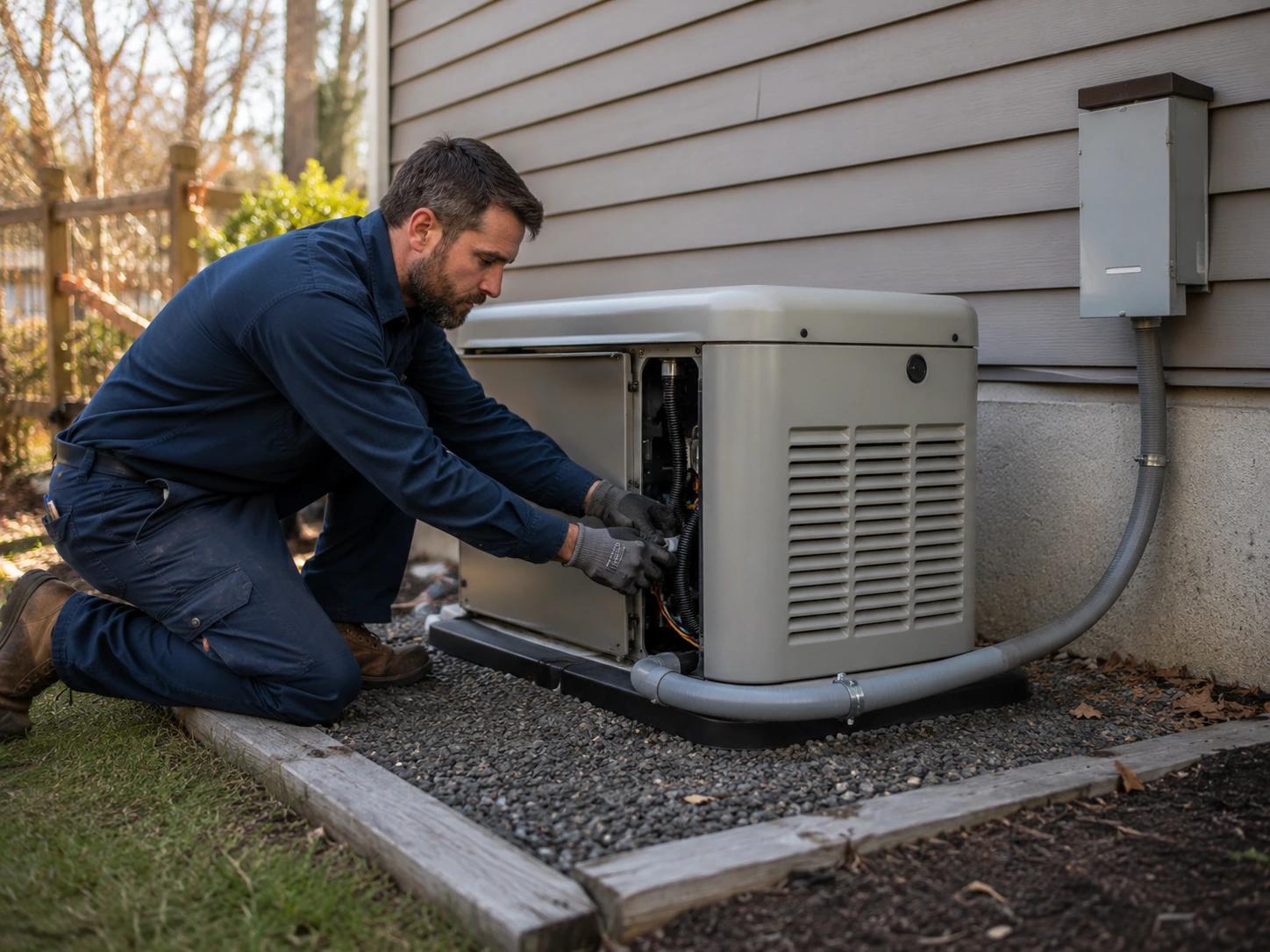
A permanently installed whole-home standby generator eliminates every one of these vulnerabilities. Operating quietly outside like a central air conditioner and connected directly to your municipal natural gas line, an automated standby system restores full electrical power to your home within 10 to 20 seconds of a blackout—completely automatically.
This definitive guide covers everything Ontario homeowners must know before investing in emergency backup power: portable vs. standby engineering, generator kilowatt (kW) sizing, Automatic Transfer Switches (ATS), TSSA gas clearances, ESA permit mandates, and how to get an accurate on-site assessment from a Licensed Electrical Contractor (LEC).
1. Portable vs. Whole-Home Standby Generators: Engineering Comparison
Before investing in backup power, homeowners must weigh the practical differences between a temporary portable unit and a permanent standby system:
| Performance & Operational Factor | Portable Generator (Gasoline / Dual-Fuel) | Whole-Home Standby Generator (Natural Gas / Liquid Propane) |
|---|---|---|
| Startup & Activation | 100% Manual. Must be wheeled outside, fueled, pull-started, and plugged in during a storm. | 100% Automatic. Senses outage and restores power in under 15 seconds, whether you are home or asleep. |
| Fuel Source & Supply | Stored Gasoline / Propane Tanks. Gas spoils after 3–6 months; requires constant manual refilling in storms. | Continuous Municipal Natural Gas. Infinite fuel supply piped directly to unit; runs indefinitely. |
| Electrical Coverage | Limited. Powers 4 to 8 selected circuits via extension cords or a manual interlock switch. | Whole-Home. Simultaneously powers HVAC, sump pumps, kitchen appliances, lighting, and EV chargers. |
| Weather & Safety Enclosure | Vulnerable. Cannot be safely run in rain or snow without specialized tents; carbon monoxide risk. | Protective Acoustic Enclosure. Heavy-duty aluminum or galvanized steel engineered for Canadian winters (-30°C). |
| Grid Isolation Protection | High risk of dangerous utility backfeeding if operated without professional mechanical interlock. | Certified Automatic Transfer Switch (ATS) provides foolproof mechanical utility isolation. |
| Impact on Property Value | Zero permanent property equity added. | Significant permanent increase in home marketability and appraisal value across the GTA. |
2. Standby Generator Sizing: How Many Kilowatts (kW) Does Your Home Need?
Standby generators are measured by their electrical power output in kilowatts (kW). Sizing a generator is not about matching the physical square footage of your home; it is about calculating the starting (inrush) wattage and running wattage of the specific electrical systems you need to operate during a blackout.
Under Section 8 of the Ontario Electrical Safety Code (OESC), residential load calculations determine whether a generator should be configured for essential circuit protection or whole-home coverage:
| Generator Power Output (kW) | Recommended Home Profile | Supported Household Systems & Equipment | Electrical Configuration |
|---|---|---|---|
| 10 kW – 14 kW | Essential Circuit Backup (Townhomes, semi-detached, modest single-family homes) | High-efficiency gas furnace blower, sump pump, refrigerator/freezer, Wi-Fi, LED lighting, security system, and garage door opener. | Managed 16-circuit subpanel or load-shedding transfer switch. |
| 18 kW – 22 kW | Standard Whole-Home Backup (2,000 – 3,500 sq ft single-family homes with 200A service) | All essential circuits PLUS central air conditioning or cold-climate heat pump, electric range, microwave, and electric clothes dryer. | Full 200A service-disconnect Automatic Transfer Switch (ATS). |
| 24 kW – 26 kW+ | Executive & High-Demand Properties (3,500+ sq ft homes, rural estates, high-draw electrification) | Complete, uncompromised household power: multiple central HVAC units, finished basement rental suites, pool pumps, hot tubs, and Level 2 EV charging. | Full 200A or 400A split-service transfer switches with smart load management. |
The Critical Role of Inrush (Starting) Current
One of the most frequent mistakes made by uncertified contractors is sizing a generator based strictly on "running watts."
Appliances driven by electric motors and compressors—such as air conditioners, heat pumps, well pumps, and heavy sump pumps—require three to five times more electrical current for two to three seconds during startup than they consume while running continuously.
If your generator does not have sufficient surge capacity to handle this initial inrush current, the generator's engine will bog down, causing voltage sags that trip breakers or damage sensitive electronic equipment inside your home.
Smart Power Management & Load Shedding
To prevent over-sizing an unnecessarily massive generator, modern systems utilize Smart Load Shedding Modules (LSM).
If your home has multiple high-draw appliances (such as a 5-ton heat pump, an electric oven, and a hot tub), smart modules prioritize life-safety circuits (heating and sump pumps) while momentarily holding off non-essential loads. Once the high-demand appliance cycles off, secondary circuits are automatically re-energized.
3. The Brain of the System: How the Automatic Transfer Switch (ATS) Works
A standby generator cannot function without an Automatic Transfer Switch (ATS). The ATS is the intelligent command center that bridges your municipal utility grid, your generator, and your home's main electrical distribution board.
| Power System Component | Role in Emergency Power Architecture | Safety & Control Function |
|---|---|---|
| Municipal Power Grid | Primary utility source (Toronto Hydro / Alectra / Hydro One) | Monitored 24/7 by the ATS sensing relays for voltage loss or frequency collapse. |
| Automatic Transfer Switch (ATS) | Central intelligent mechanical isolation gateway | Instantly disconnects grid feed before transferring power; prevents dangerous backfeeding. |
| Standby Generator | Dedicated on-site secondary power plant (Natural Gas) | Auto-starts, synchronizes voltage, and energizes home breaker panel within seconds. |
The 5-Stage Automated Power Restoration Sequence:
| Sequence Phase | Operating Milestone | Operational Actions & Grid Isolation |
|---|---|---|
| Phase 1: Grid Interruption | Loss of Utility Voltage | The ATS continuously senses line voltage. If utility power drops below threshold for 3 seconds, it initiates the emergency sequence. |
| Phase 2: Engine Startup | Generator Ignition | The generator's starter engages, running on natural gas. The engine stabilizes at operational speed (typically 3,600 RPM) within 5–10 seconds. |
| Phase 3: Mechanical Transfer | Utility Grid Isolation | The ATS mechanically switches contacts, severing physical connection with the street grid and directing generator power into the home. |
| Phase 4: Continuous Backup | Emergency Power Delivery | Electricity flows safely across all designated home circuits. The ATS monitors utility lines in the background. |
| Phase 5: Seamless Re-Transfer | Grid Restoration & Cool-Down | When utility power is steady for 60 seconds, the ATS transfers the home back to the grid and runs the generator for a 2-minute cool-down cycle. |
The Lethal Danger of "Backfeeding" Without an Approved Transfer Switch
Under the Electricity Act and OESC Section 46, connecting any generator directly into a household outlet or breaker panel without an approved transfer switch or mechanical interlock is a serious provincial offense.
When an uncertified operator plugs a generator into a dryer outlet or connects it without isolating the main breaker, electricity flows backward through your home's service mast, through the utility transformer on the street, and steps up to thousands of volts across local utility lines.
This lethal phenomenon, known as utility backfeeding, can severely burn or electrocute utility line workers who are working in sub-zero blizzards to repair downed lines. A code-compliant Automatic Transfer Switch provides an impenetrable mechanical barrier that makes backfeeding physically impossible.
4. Regulatory Compliance: ESA Electrical Standards & TSSA Gas Clearances
Installing a whole-home standby generator in Ontario requires satisfying two separate provincial regulatory bodies:
- The Electrical Safety Authority (ESA): Oversees the high-voltage electrical interconnections, transfer switch mounting, grounding electrode systems, and overcurrent protection under the Ontario Electrical Safety Code.
- The Technical Standards and Safety Authority (TSSA): Oversees fuel storage, natural gas piping, regulator pressures, and exhaust clearances under the Ontario Fuel Gas Code (CSA B149.1).
Mandatory Outdoor Placement & Clearance Standards:
| Safety Parameter | Regulatory Standard (TSSA & Building Code) | Engineering & Life-Safety Rationale |
|---|---|---|
| Distance to Windows & Doors | Minimum 5 Feet (1.5 Meters) | Prevents deadly carbon monoxide (CO) exhaust from being drawn into living spaces through operable windows, doors, or vents. |
| Distance to Fresh Air Intakes | Minimum 10 Feet (3.0 Meters) | Eliminates risk of generator exhaust entering mechanical ventilation, furnace intakes, or heat recovery ventilators (HRV). |
| Clearance to Combustible Walls | Minimum 3 Feet (or 18 Inches if Certified) | Prevents thermal heat transfer to vinyl siding or wooden framing; enables adequate engine airflow for cooling. |
| Distance to Gas Meter Regulators | Minimum 3 Feet Separation | Prevents electrical ignition sources from operating near natural gas relief vents. |
| Elevated Concrete / Composite Pad | Minimum 4–6 Inches Above Grade | Keeps generator mechanicals elevated above Ontario snow lines, standing water, and spring thaw pooling. |
Failing to adhere to these clearances will result in immediate defect notices from ESA inspectors or utility gas shutoffs, leaving your system non-operational and non-compliant with home insurance policies.
5. What Factors Determine Your Project Scope? (Why Custom Quotes Are Mandatory)
Property owners frequently search online for a quick, fixed dollar estimate for standby generator installation. However, every home possesses a unique physical layout, gas service capacity, and utility connection path, making standardized flat-rate online pricing misleading and inaccurate.
Reputable Licensed Electrical Contractors do not provide blind pricing without evaluating the specific structural parameters of your property.
Key Site Variables That Determine Your Installation Requirements:
| Site Parameter | Technical & Engineering Impact on Project Scope |
|---|---|
| Gas Meter to Generator Distance | Standby generators require significant fuel flow (often 150,000 to 250,000 BTU/hr). If your gas meter is on the opposite side of the home from the generator pad, running larger-diameter black iron pipe or underground CSST gas line requires specialized routing. |
| Generator to Electrical Panel Distance | Running heavy copper conductors, conduit, and low-voltage control wiring from an outdoor generator pad across finished basements or around landscaping demands substantial labor and materials compared to back-to-back configurations. |
| Main Service Amperage (100A vs 200A vs 400A) | Sizing the physical Automatic Transfer Switch to match your home's main service entrance directly dictates hardware dimensions and installation complexity. |
| Gas Meter Regulator Capacity | Adding a 200,000+ BTU generator load may require your gas utility (Enbridge) to upgrade your residential gas meter or pressure regulator to ensure adequate winter gas delivery. |
| Ground Preparation & Pad Construction | Installing a heavy standby unit requires excavating topsoil, leveling crushed limestone aggregate, and installing a reinforced pre-cast composite pad or pouring a custom concrete slab. |
| Municipal Noise & Property Line Bylaws | Certain GTA municipalities (such as Toronto, Markham, or Vaughan) enforce strict property-line setback rules and decibel noise limits, dictating unit placement and acoustic enclosure specifications. |
Avoid Unlicensed Operators and Shortcut Installations: Rogue handymen frequently install standby units too close to bedroom windows, fail to pull mandatory ESA permits, or undersize gas piping so the unit starves of fuel during cold winter starts. Always partner with a certified contractor who provides a comprehensive written proposal covering all electrical permits, gas coordination, concrete staging, and ESA sign-offs.
Contact our licensed master electricians today to arrange a thorough, no-obligation on-site standby generator assessment.
6. Industry-Leading Standby Generator Brands We Install & Maintain
Our master electricians partner with North America's premier standby generator manufacturers, engineering custom backup solutions tailored to your property:
1. Generac Guardian Series (10 kW – 26 kW)
- Market Leader: Generac is the most widely installed home standby generator brand in Canada.
- Key Features: True Power™ electrical technology delivers less than 5% total harmonic distortion (THD) for clean power to smart appliances. Includes Mobile Link™ remote Wi-Fi monitoring to track unit status from your smartphone.
- Enclosure: Sturdy RhinoCoat™ powder-coated aluminum enclosures engineered for extreme resistance to Canadian road salt, snow, and rust.
2. Kohler Residential Power Systems (14 kW – 26 kW)
- Commercial-Grade Reliability: Renowned for commercial-grade hydraulic valve lifters and heavy-duty industrial alternator designs.
- Quiet Operation: Advanced acoustic baffling delivers exceptionally low decibel ratings during weekly self-test cycles.
- Fast Response: Restores household power within 10 seconds of utility failure.
3. Cummins QuietConnect Series (13 kW – 20 kW)
- Ultra-Quiet Suburban Performance: Specifically designed for tighter suburban lot lines across Toronto and North York where sound containment is critical.
- Extreme Cold Weather Packages: Available with factory-engineered battery warmers, oil heaters, and cold-start technology reliable down to -30°C.
7. Serving Toronto and the Entire Greater Toronto Area (GTA)
Our certified electrical technicians deliver complete, code-compliant standby generator installations, transfer switch upgrades, and utility coordination across all primary GTA service areas:
- Etobicoke & Mimico: Sizing and installing standby generators for older residential properties, lake-effect storm zones, and homes with aging overhead grid connections.
- Vaughan & Woodbridge: Complete 20 kW – 26 kW whole-home installations for executive properties, high-amperage transfer switches, and Enbridge gas meter coordination.
- Mississauga & Oakville: Sump pump protection, whole-house backup power for estate residences, and underground trenching.
- Toronto & Central Core: Tight lot line compliance, acoustic soundproofing, and century home transfer switch integrations across High Park, The Annex, and North Toronto.
- Markham & Richmond Hill: Complete service entrance transfer switches, multi-system load shedding, and smart generator integration.
- North York & Scarborough: Backup power solutions for residential medical equipment, finished basement suites, and rural/suburban transition corridors.
Related reading: Portable vs. Standby Generator: What Ontario Homeowners Should Know · Solar Panel Installation: Why the Electrical Work Behind the Panels Matters
Secure Your Home with Reliable Standby Power
When extreme winter weather strikes Ontario and the power grid collapses, you shouldn’t have to worry about freezing pipes, flooded basements, or dark, frigid living rooms.
Entrusting your standby generator installation to the licensed master electricians at Electrovoltage guarantees seamless automation, complete code compliance, and permanent peace of mind. From performing your initial load calculation and handling gas coordination to installing the Automatic Transfer Switch and securing your official ESA Certificate of Acceptance, our team manages every step with precision.
Contact our team today to discuss your backup power requirements and schedule your comprehensive, on-site generator assessment:
- 📞 Direct Phone: (416) 828-6976
- 📧 Email Inquiries: info@electrovoltage.ca
- 🌐 Online Consultation: Schedule Your Standby Generator Assessment Online
- 🛡️ Licensing & Credentials: Fully Licensed Electrical Contractor (ECRA/ESA #7017240) | Licensed Master Electricians | Fully Insured | WSIB Coverage