
August 16, 2026
Call (416) 828-6976Does Home Insurance Require Knob-and-Tube Wiring Removal in Toronto? (What Code & Insurers Say)
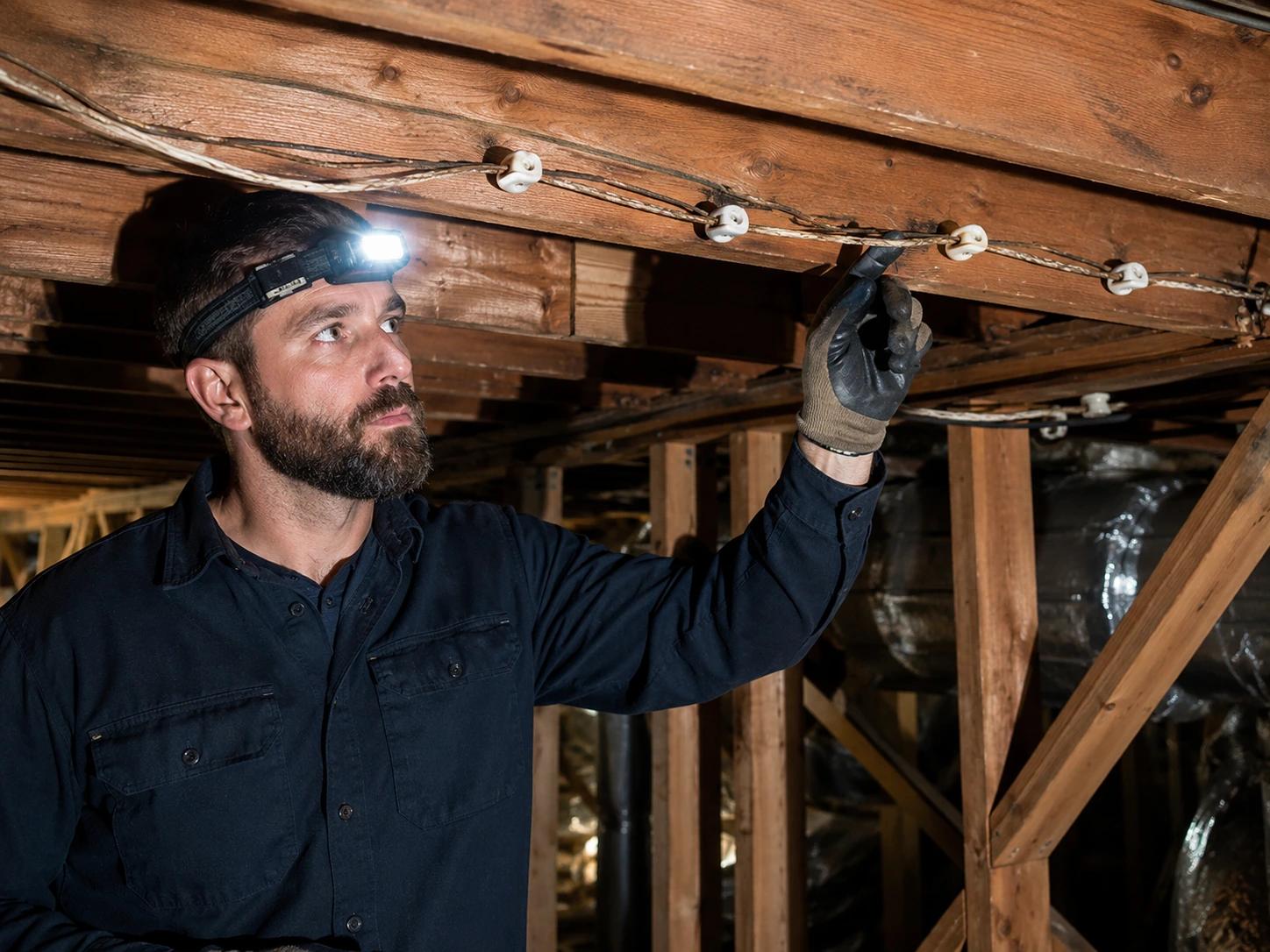
If you've been told your home insurance renewal, home purchase, or mortgage refinancing is contingent on removing knob-and-tube wiring, you're dealing with one of the most common real estate and insurance hurdles in Toronto's historic housing stock.
Here is what knob-and-tube wiring actually is, whether it is legal in Ontario, why insurers refuse coverage, and what your options are.
What Is Knob and Tube Wiring?
Knob-and-tube (K&T) wiring was the standard electrical wiring method installed in North American homes between approximately 1880 and 1950.
Unlike modern Romex (NMD90) cables, which bundle black (hot), white (neutral), and bare copper (ground) conductors inside a single flame-retardant plastic sheath, knob-and-tube wiring consists of:
- Separate Open Conductors: The hot and neutral wires are run as separate, individual insulated copper wires, spaced at least three inches apart along framing timbers.
- Porcelain Knobs: Cylindrical ceramic knobs nailed to wall studs and floor joists that elevate the wire away from combustible wood framing.
- Porcelain Tubes: Cylindrical hollow ceramic tubes inserted through holes drilled into wooden floor joists to protect conductors from friction and contact with wood.
- No Ground Wire: Knob-and-tube wiring has no grounding conductor. It only supports two-prong receptacles and provides zero protection against ground faults, power surges, or equipment faults.
Is Knob and Tube Wiring Legal in Ontario?
Homeowners often ask: is knob and tube wiring legal in Ontario, or is it a code violation?
Under the Ontario Electrical Safety Code (OESC), existing knob-and-tube wiring is NOT illegal if it remains in its original, safe condition.
The code allows pre-existing electrical installations to remain in service as long as they complied with the electrical code in effect when originally installed and show no evidence of damage, overheating, or unauthorized modification.
What IS Illegal Under Ontario Electrical Code:
- Adding New Outlets or Extending Circuits: Code strictly prohibits extending, splicing, or adding modern receptacles, switches, or lighting fixtures directly onto knob-and-tube wiring.
- Covering It with Thermal Insulation: Knob-and-tube wiring relies on open-air circulation to dissipate heat generated by electrical current. Under OESC rules, burying knob-and-tube wiring under blown-in cellulose, fiberglass, or spray-foam attic insulation is a severe code violation and a direct fire hazard.
- Over-fusing Circuits: Screwing 20A or 30A fuses into vintage fuse panels to prevent 15A circuits from blowing when running modern appliances is illegal and dangerously overheats the wires.
Why Insurers Won't Touch It
While the Electrical Safety Authority does not force you to rip out intact knob-and-tube wiring, Ontario home insurance underwriters operate under their own commercial risk rules.
Almost all major Canadian home insurance providers (including Intact, Aviva, Desjardins, TD, and Wawanesa) take a strict stance:
- Refusal to Write Policies: Insurers will decline to issue a new home insurance policy on a newly purchased home with knob-and-tube.
- Conditional Coverage Periods: Some insurers grant a temporary 30- to 60-day binder window after closing, requiring proof of complete remediation before full coverage is ratified.
- Non-Renewal Notices: Insurers undergoing portfolio audits frequently send homeowners cancellation notices unless the system is replaced and certified by an ESA inspector.
The insurers' hesitation is backed by hard fire statistics: age-related rubber degradation, lack of grounding, amateur junction splices inside walls, and modern heavy electrical loads (microwaves, laptops, space heaters) that this 80-year-old system was never designed to carry.
Full Rewire vs. Partial Replacement
A full whole-home rewire removes every trace of knob-and-tube from the basement to the attic, satisfying every insurance underwriter outright.
However, in many older Toronto and GTA homes, portions of the electrical system have already been modernized over the decades during kitchen, bathroom, or basement renovations. In these properties, a targeted knob-and-tube remediation — tracing every circuit, disconnecting only the active vintage lines, and feeding those rooms with new NMD90 home-runs — can eliminate the hazard at a fraction of the cost.
Before quoting any work, our Master Electricians conduct an exploratory assessment to verify exactly what percentage of your wiring is active knob-and-tube versus modern grounded copper.
Does Knob-and-Tube Removal Mean Destroying Walls?
No. You do not need to gut your walls or tear down historic lath and plaster.
Specialist electrical contractors use surgical, non-destructive wiring techniques:
- Fishing flexible NMD90 cables through floor cavities, cold-air returns, and wall cavities using specialized fiberglass rods and flexible drill bits.
- Making minimal, small access pockets (typically the size of a smartphone) in drywall or plaster, which are easily patched.
- Preserving original baseboards, crown moulding, and architectural plasterwork throughout heritage century homes.
What Documentation Your Insurer Actually Demands
When your insurer asks for proof, they will not accept an invoice or a note from a handyman. They legally require an official Electrical Safety Authority (ESA) Certificate of Acceptance.
As a Licensed Electrical Contractor (ECRA/ESA #7017240), Electrovoltage pulls the required ESA notification/permit before starting work. Once the replacement is completed, an official ESA field inspector inspects the remediation and issues the final Certificate of Acceptance confirming that no active knob-and-tube wiring powers your branch circuits. This certificate is the gold standard that insurers require to issue or maintain your policy without penalties.
Get Your Century Home Assessed Before the Deadline
We trace vintage wiring, isolate what is original versus already updated, and complete seamless knob-and-tube and aluminum wiring replacement — with specialized teams for Scarborough knob-and-tube remediation and Toronto historic homes — backed by official ESA certification across Toronto and the GTA. Contact us or call us directly at (416) 828-6976 to schedule your assessment before your insurance deadline hits.
Frequently Asked Questions
- What is knob-and-tube wiring?
- Knob-and-tube (K&T) wiring is an early standardized electrical wiring method used in Ontario homes from the 1880s through the late 1940s. It features single copper conductors supported by cylindrical ceramic porcelain knobs along wall studs and routed through ceramic tubes inside floor joists, with hot and neutral wires running completely separate and without an equipment ground wire.
- Is knob-and-tube wiring legal in Ontario?
- Yes, existing knob-and-tube wiring is technically legal under the Ontario Electrical Safety Code (OESC) provided it is untouched, undamaged, properly fused, and not covered by thermal insulation. However, installing new knob-and-tube, extending circuits, or burying it under attic insulation is illegal. Furthermore, nearly all Ontario home insurers legally refuse to insure homes with active knob-and-tube wiring.
- Why do Ontario home insurance companies refuse knob-and-tube wiring?
- Insurers refuse coverage because knob-and-tube has no ground wire (leaving modern appliances and electronics vulnerable to fire and shock), its vintage rubberized cloth insulation becomes brittle, and homeowners historically over-fused 15A circuits with 20A/30A fuses or covered conductors in blown-in insulation, creating severe concealed fire hazards.
- Does knob-and-tube wiring removal mean tearing down all the drywall or plaster?
- No. Experienced licensed electrical contractors fish modern NMD90 Romex copper cables between floors, wall cavities, and ceiling bays using specialized flex bits and small, surgical access cuts, preserving original lath, plaster, and heritage architectural trim.
- What proof do Toronto and Ontario home insurers ask for after knob-and-tube removal?
- Ontario insurance underwriters require an official Electrical Safety Authority (ESA) Certificate of Acceptance issued to a Licensed Electrical Contractor (ECRA/ESA), legally certifying that all active knob-and-tube branch wiring has been disconnected, removed, or made completely inert.
Related Service
Aluminum Wiring Replacement
Aluminum wiring repair and replacement to reduce fire risk and meet insurance requirements.
Get Started
Request a Quote Today
Tell us about your project and we'll get back to you with a quote.